
Deterrence to Disarmament: How I Began to Support the Nuclear Weapons Ban Treaty
Lipi Shetty March 30, 2026
The first time I was confronted with the vast, destructive power of an atomic bomb was in my
seventh-grade classroom. We were reading Bomb: The Race to Build—and Steal—the World’s Most
Dangerous Weapon. The book ended with a description of the horrific bombings of Hiroshima and
Nagasaki.
In high school, history classes began to touch on the atomic bombs again. However, much of the
teaching focused on the Manhattan Project, rarely confronting the bombings of Hiroshima and Nagasaki,
and if so only framing them as a debate. Should we or should we have not bombed Hiroshima and
Nagasaki? For me, it was all too obvious, we should not have. However, many of my classmates and even
my teachers subscribed to the idea that the bombings were a “necessary evil,” an idea that has been
widely proven wrong by historians and scholars.
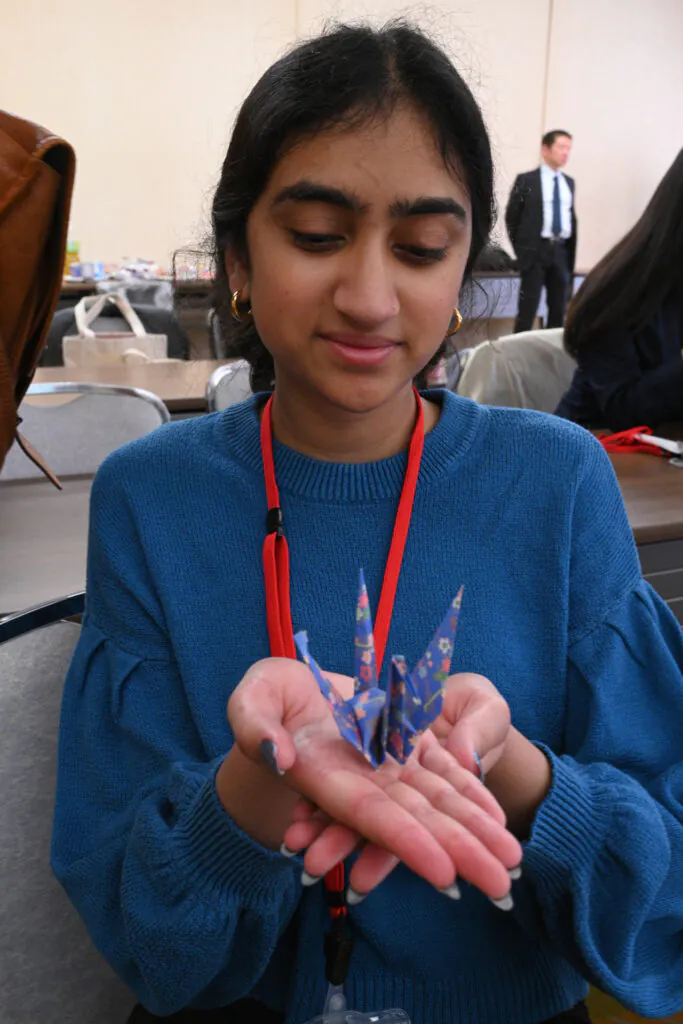
In university, I revisited nuclear weapons from a physics perspective, taking a course at the University of Illinois at Urbana Champaign titled “Physics 280: Nuclear Weapons and Arms Control” taught by Dr. Matthias Grosse Perdekamp. It was through this course that I was recommended to join the Center for Nonproliferation Studies’ Young Women in Nonproliferation Initiative, a program which matched students to mentors in nonproliferation, disarmament, and arms control fields worldwide. My mentor was Maria Antonieta “Tonie” Jácquez Huacuja, coordinator for disarmament and nonproliferation at
the Mexican Ministry of Foreign Affairs.
Tonie first enlightened me to the deep inequity embedded in our current nuclear weapons status quo,
which is characterized by states possessing nuclear weapons – the United States, Russia, the United
Kingdom, France, Israel, India, Pakistan, and North Korea – and then nonnuclear weapons states, which
are the rest of the world. I learned of the injustices faced by women, Indigenous communities, and the
people of the Global South in upholding this regime, and how these same communities spearheaded social movements to ban the bomb. She described to me how Mexico supports the Treaty on the Prohibition of Nuclear Weapons (TPNW), a treaty that bans all nuclear weapons activities. For the first time, I saw a path forward, one that didn’t rely on the fickle nature of deterrence and mutually assured destruction. Seeking to further my involvement in nuclear weapons abolition and to learn more about the nuclear ban treaty, I applied to the Hiroshima-ICAN Academy a year later, hosted by the Hiroshima Prefectural Government and the International Campaign to Abolish Nuclear Weapons, the coalition of global organizations largely credited for the passage of the TPNW.
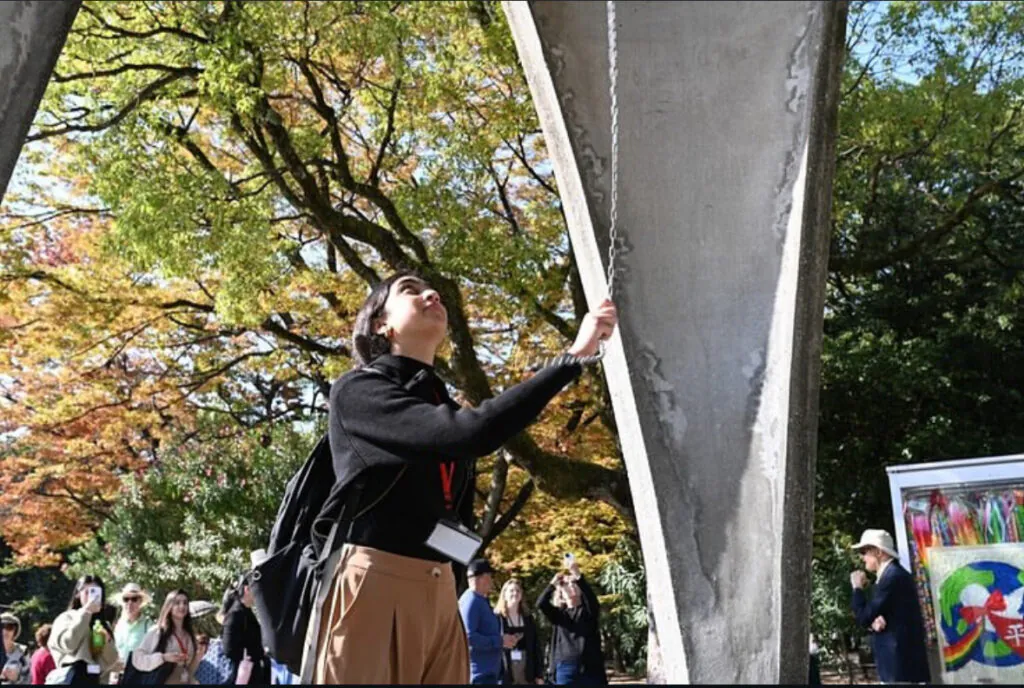
When I first arrived in Hiroshima City as a participant in the Hiroshima ICAN Academy, I expected to feel the overwhelming weight of its history immediately. However, the city’s rich culture, beautiful scenery, and warm people made it difficult to imagine the horrors that once engulfed it decades prior. It was only as we began our program of activities, starting with the testimony of Hibakusha, or survivors of the atomic bombings, that I began to feel the depth of the city’s history. On August 6, 1945, when the United States dropped the atomic bomb on Hiroshima City, Keiko Ogura was eight years old. She recalled the haunting cries of those in pain, calling out for water. She described her guilt for giving these victims water, fearing she caused their immediate death. Ms. Ogura continues to tell this painful story again and again so that nobody will have to experience what she and so many others did on August 6th. As we spoke and explored the city, I reflected deeply on its past. On our last night, we gathered at the Genbaku Dome, or Atomic Bomb Dome, for a protest, calling for the end of Israel’s genocide in Gaza. Throughout the trip, I could truly feel the deep resiliency that echoed throughout Hiroshima City. A city that had been through such tragedy and had begun to rebuild itself just two days after, and a city that chose to make peace a hallmark of its culture and grassroots advocacy.

Later we had the opportunity to hear from Robert Jacobs, author of the book “Nuclear Bodies: The Global Hibakusha”. Through him, we learned of the vast legacy of nuclear weapons testing and the fallout that spread across the planet. He taught us the term “Global Hibakusha” which refers to the global population affected by nuclear weapons production, testing, fallout, and waste disposal. During his lecture, I saw the term “nuclear colonialism” clearly exemplified. Nuclear colonialism refers to the “system of domination through which governments and corporations disproportionately target and devastate Indigenous peoples and their lands to maintain the nuclear production process,” coined by activists Ward Churchill and Winona LaDuke in 1986. I was able to make clear connections to works like Jean-Paul Sartre’s Colonialism Is a System, which argues that colonialism is a deliberate system of economic exploitation rather than a series of isolated decisions. Colonialism is characterized by land dispossession, resource extraction, and economic exploitation, and nuclear colonialism reflects these same dynamics, carried out by nuclear-armed states in the development and maintenance of their arsenals.
After these experiences, it became clear to me that nuclear weapons pose too great a humanitarian and
environmental threat to rely on the fragile logic of deterrence as the primary way to prevent their use. I
realized that nuclear policy must heed the voices of those who truly understand the intergenerational and deeply enduring harms of nuclear weapons: the people and communities who have been directly affected by them. The Treaty on the Prohibition of Nuclear Weapons represents the culmination of the efforts of the global hibakusha, whether from Hiroshima, the Marshall Islands, Kazakhstan, or Western Shoshone lands. Supporting the Treaty on the Prohibition of Nuclear Weapons means choosing a future where no community must endure the devastation that nuclear weapons have already inflicted. We must continue to work toward a world without nuclear weapons as our ultimate goal. It is a future that is not only possible, but necessary.
Lipi Shetty was a Spring 2025 Scoville Fellow at the Arms Control Association.