
The Importance of Interdisciplinarity
Grace Connors December 4, 2025
I sank into the cushioned seat of the auditorium, slightly out of breath from racing across campus to make the 3pm start. Just as I was looking around for any familiar faces, the lights dimmed.
“Good afternoon, I’m Dr. Lisa Schirch, and I’m here to talk about digital peacebuilding.”
Goosebumps shot up my arms. As one of two students pursuing a computer science and peace studies degree at the University of Notre Dame, I had spent the past three years finding responses to questions like “Interesting major, how do those go together?” or “How are you ever going to get a job in that?” every time I shared my studies with someone new. For an overlap that had always made plain sense to me yet was seemingly unimaginable to others, Dr. Schirch had suddenly given me a name for an entire field that innately understood this overlap. This wasn’t just another lecture for me; it felt like a calling.
From that point forward, I knew I wanted to be a digital peacebuilder. Did I yet know what that looked like in a job title? Perhaps not, but I resolved to explore this field as intentionally as I could. I took Dr. Schirch’s Introduction to Digital Peacebuilding graduate course during my senior fall, ultimately joining her PeaceTech and Polarization Lab as a Research Assistant before that semester concluded. In addition to the research, this RA role brought me the opportunity to attend conferences in San Francisco, Nairobi, and Waterloo, Canada—the latter funded using my travel grant from the Scoville Fellowship—where I was welcomed into a community of digital peacebuilders. For the first time, I was greeted with words of support and encouragement rather than confusion when I introduced my background to new people. And this community in turn helped me fill in those initial questions I had about job titles; I engaged with researchers, product designers, communicators, artists, software developers, policymakers, trust and safety professionals, and more, all tirelessly working towards a vision of a safer, more prosocial online environment. Years later, I now call many folks in this community close friends and have worked on countless exciting projects as a result.
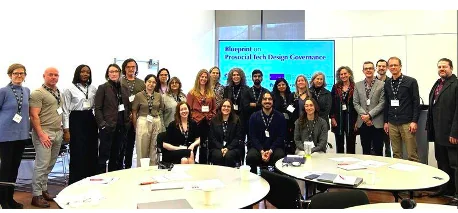
Connors at the Blueprint on Prosocial Tech Design Conference in Waterloo.
When she walked into the auditorium that day, Dr. Schirch had no way of knowing that her inaugural lecture at Notre Dame, a requirement of all new peacebuilding faculty, would be the impetus that inspired my career and my vocation. Our research together since, and the work I’ve been able to do as I’ve explored the digital peacebuilding space, continues to affirm my vocation as an interdisciplinary digital peacebuilder. Thus, when I was granted the opportunity to present on various dimensions of this work to university students around the U.S., I jumped at the chance to be the bridge into interdisciplinary academia that Dr. Schirch was for me.

Connors presenting at the University of Maryland.
I first spoke at the University of Maryland through a partnership with the Center for International and Security Studies in the School of Public Policy (SPP). As a research assistant affiliated with another department in SPP, the Do Good Institute, the partnership was natural, though the work I presented on was a passion project I had completed outside of my role at UMD. In the presentation, I shared the findings of a study I completed with digital peacebuilder Emma Baumhofer for the Berghof Foundation and the Plattform Zivile Konflikt Bearbeitung on how platform design amplifies disinformation, what peacebuilders are currently doing to respond to disinformation online, and how that work can be improved using lessons from social psychology.
Sharing our findings with a room full of international security studies students was fascinating, as their questions focused largely on the security dimensions of peacebuilding disinformation work. Students wanted to know how malicious actors manipulated platform design to disrupt the information ecosystem and wanted clear steps on how to counter these attacks. This stood in slight contrast to many of the peacebuilders with whom I had discussed our study, who dove deep on our recommendations for improving their programming and approach to countering disinformation. Once again, I was reminded of the importance of engaging with a variety of stakeholders to continue informing my approach to digital peacebuilding work.
A few weeks later, I co-led a lecture to a public policy undergraduate class at the Catholic University of America (CUA), where I am now pursuing my PhD in Computer Science. In the theme of interdisciplinarity, and in recognition of how my faith inspires my approach to my digital peacebuilding work, this presentation focused on introducing students to the concept of Catholic-informed digital peacebuilding. Largely, I gave concrete examples of how digital peacebuilders are responding to Pope Francis’ call for an online environment grounded in a culture of authentic encounter, focused on transparency, and which leverages AI for the common good. My co-presenter was Dr. Maryann Love, Associate Professor of International Relations at CUA, consultant to the Holy See Mission at the UN, and a Pope Francis appointee to the New Technologies for Peace task force. Once I gave this general framework for digital peacebuilding, Dr. Love spoke directly to her experience in the policymaking side of this field, grounding the conversation in practical, real-world policy discussions. Dr. Love shared the many challenges new technologies and AI pose to the mission of the Church and how she and her colleagues are working on creating norms and ethical guidelines at the international level to better guide their stewardship towards peaceful ends. Given that we were speaking to a room full of policy students, their questions focused primarily on the enforcement of these policies and the future of this work, as well as how partnerships between policymakers and technology developers like myself could be forged to ensure new technologies align with peaceful goals right from their creation. Similar questions arose this fall, when I was invited by Dr. Love to present to her AI Ethics students on digital peacebuilding and deliberative democracy.

Connors after speaking with students.
Overall, while each presentation I gave was unique in focus, all centered around the broader theme of interdisciplinarity. Peacebuilding, computer science, political science and policymaking, and social psychology—lessons from all of these fields and more are necessary if we are to build a better online ecosystem. Engaging with students across all of these spaces was invigorating, and their questions inspired me to continue thinking deeply about the role of my work amidst the broader digital peacebuilding landscape. Perhaps best of all, one student came up after my presentation at UMD and thanked me for finally giving him a name for the research about which he was passionate. He’d never heard the phrase “digital peacebuilding” before, but he knew he wanted to be a digital peacebuilder. Knowing that I achieved the goal I set out to accomplish, namely to be the key to inspiration that Dr. Schirch was for me, was the best feeling, and I hope to continue to inspire future students throughout my studies.
Grace Connors was a Spring 2024 Scoville Fellow at Rethink Media.