
Lessons from Aotearoa: My introduction to international peace by a nuclear-free nation
Celia McDowall, October 20, 2025
I was first introduced to nuclear peace and security in Aotearoa New Zealand, a staunchly and proudly anti-nuclear country, where I lived and studied from 2020 to 2024. The lessons Aotearoa taught me—most notably, that a nation’s security should prioritize the wellbeing of its people and environments, and that international peace should be a collective effort towards humanitarian wellbeing—have shaped my relationship with nuclear issues and the beginning of my career in DC.
Growing up, I wanted to be a therapist. International peace and security never felt like a tangible field of study or work to pursue, in part because it felt inaccessible and in part because the America-first approach to foreign policy never spoke to me. Until moving to New Zealand, I only knew I was academically interested in people’s psychologies and personally passionate about meeting and understanding new cultures. International peace and security, once in my sight, spoke to me out of curiosity about the people who sit at the decision-making table and care for the well-being of the people those decisions are imparted on. My interest in nuclear policy stems directly from that core humanitarian interest and was fostered by this unique opportunity to live and study in New Zealand.
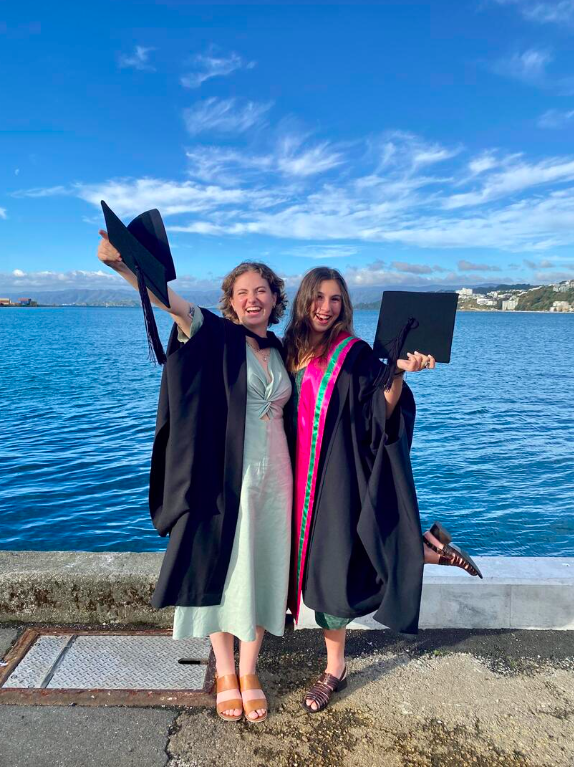
I pursued and completed my undergraduate and postgraduate degrees at Te Herenga Waka, the Victoria University of Wellington. In my fourth year, as a Master of Strategic Studies student, I took a course on contemporary nuclear politics and was introduced to nuclear peace and security as a field of study. Aotearoa New Zealand is a small but mighty country in nuclear nonproliferation and disarmament. My course dedicated entire lesson sections to nuclear harms and legacies, something my professor admitted was rare at American universities. Learning about the history and current salience of nuclear weapons through this lens greatly shaped my beliefs and motivations.
To me, New Zealand is a model for what can be done. Disarmament is regarded by nuclear-armed states and nuclear-reliant allies as being too hard or risk-inviting, but in 1984 New Zealand denied a US warship entry to its ports because officials would not confirm or deny whether it was nuclear capable. The move lost New Zealand its security guarantees from the US under ANZUS, a sacrifice it happily made in favor of standing on its anti-nuclear values. A small but mighty country, Aotearoa knows how to stand on its morals and align its national security accordingly. These principles are at the heart of the Treaty of Rarotonga, the legal entity of the South Pacific Nuclear Weapon Free Zone, to which New Zealand is a proud and leading member.

New Zealand’s nuclear policy extends from its approach to national security that prioritizes humanitarian well-being over militarized protection of land. Many official engagements begin with a mihi, a formal introduction that includes recitation of the speaker’s pepeha. Pepeha includes a statement of the person’s mountain, river, land, and family and is often recited before the speaker gives their name. Land and people are thought of as symbiotic, and the statement of pepeha marks geological heritage as intrinsic to the speaker’s, the nation’s, and the earth’s well-being. Aotearoa’s reconceptualization of national prosperity and international security to include humanitarian and environmental well-being spoke to me. It stayed with me through my time there and has been especially front of mind as I have moved back to the United States and seen such a stark contrast in values and approaches.
Pursuing a humanitarian-oriented study of nuclear issues in a country whose priority was humanitarian well-being offered a unique opportunity to delve into topics that can otherwise be considered taboo. Nuclear theory struck me as uniquely humanitarian because of the complex psychological dynamics on which the precarious balance rests. Deterrence is inherently based on mental manipulation, and the ‘nuclear peace’ argument is dependent on assumptions of rationality in decision-makers. Anyone familiar with cognitive science and psychological tendencies would be quick to discount the applicability of economic rationality to geostrategic perception and decision-making. I hope to work on reforming the assumption of psychological rationality and uniformity in decision-making and use this to highlight the fragility of nuclear stability
Nuclear psychology is not yet a prolific area of study, despite the longstanding and growing importance of human-level analysis. It is, however, like all humanitarian approaches to international security, something I feel rooted in and motivated to advocate for. New Zealand taught me to be bold in my values and goals, a lesson that brought me to the Scoville Fellowship and stays with me as I settle into Washington, DC.
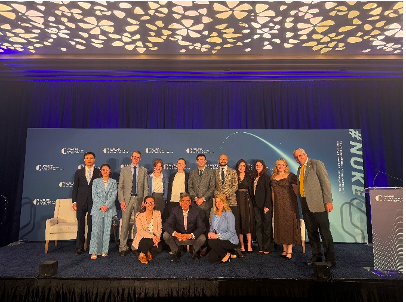
Since beginning with the Nuclear Policy Program at the Carnegie Endowment for International Peace, I have had the privilege of working with people whose work has made strides in nuclear nonproliferation and disarmament. My fellowship has allowed me to work on several projects related to my experience, including assisting with a workshop discussing the vitality of Nuclear Weapon Free Zones and conducting a personal project assessing the tradeoffs of extended nuclear deterrence to Australia. Approaching these issues from Washington, DC, is indeed a different experience. The dedication of those around me to true international peace and security inspires me to hold on to the principles I picked up in Aotearoa and carry them with me as I find my place in the field.
Celia McDowall is a Spring 2025 Scoville Fellow for the Nuclear Policy Program at the Carnegie Endowment for International Peace